Create Your First Project
Start adding your projects to your portfolio. Click on "Manage Projects" to get started


Noninvasive Potassium Monitoring
Date
Jan 2024 - May 2024
Maintaining serum potassium levels is important for patients that have heart failure or chronic renal failure, but measuring it currently requires a blood draw done by a health care professional at a clinic or dialysis center. Studies have shown that blood potassium concentration can be quantified from electrocardiography (ECG) analysis, but this still requires a physician to administer the ECG. Our proposed solution is to create a flexible, wireless, ECG sensor to monitor potassium levels. This will require two main components, a soft ECG sensor that can attach to the body and an algorithm that can analyze the morphology of the T wave of the QRST complex to extrapolate potassium content.
Prototyping and Design Development
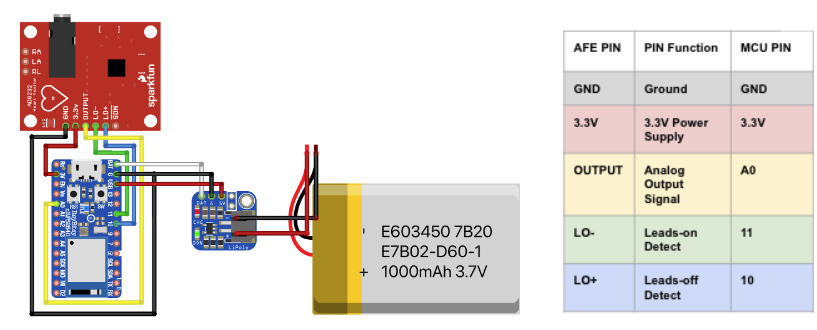
To accommodate for the resource and time constraints of the class, our primary goal is to produce a functional prototype of our intended circuitry utilizing accessible, highly compatible development components. This will be integrated with custom fabricated flexible electrodes As depicted in figure 1, our hardware will consist of three primary components, an integrated ECG front end, a microcontroller and rechargeable lithium ion battery for power management.
For our analog front-end we plan to utilize an off-the-shelf integrated circuit incorporating either the AD8232, MAX3003, ADS129x or MAX86150 biosensor. We are currently in the process of evaluating a range of options from Sparkfun, Texas Instruments and Protocentral, based on their integration of active filters, analog to digital conversion and number of lead input channels.
For our microcontroller, we have selected the Adafruit Feather Bluefruit Sense, as it has built in BLE functionality (via nrF52480) and is compatible with Circuit python libraries. The integrated Nordic nRF52480 has low-power consumption, versatile multiprotocol support and negates the need for supporting BLE components, maintaining the size requirements for a wearable. Additionally, the high-speed Cortex M4F processor and large RAM will enable efficient and reliable processing and transmission of ECG data. The circuit python compatibility of the board will enable us to use a range of open-source and built-in existing libraries, and will facilitate seamless integration of our hardware and software modules.
Although a discrete, compact wearable device would require a lightweight, small power source, for the scope of this class we have opted to utilize a 3.7 350mAh rechargeable lithium ion battery.
Pre-processing and Single-Lead Analysis
Prior to feature extraction and potassium concentration analysis, all samples collected from incoming ECG channels will require filtering and signal processing to ensure the accuracy of [K+] detection. In accordance with the most recent guidelines for signal processing and lead standardization provided by the American Heart Association (AHA), the Association for the Advancement of Medical Instruments (AAMI) and the American National Standards Institute (ANSI), our methodology will involve the following steps:
Low Pass Filter for Noise Filtering - ECG Data collected by standard instruments is typically restricted between 0.05Hz and 150Hz. Thus guidelines recommend the application of a LPF with a 150Hz cutoff frequency to remove redundant information muscle artifacts or EM interference, thereby reducing data storage and improving the accuracy of peak and wave detection [8].
High Pass Filtering to Suppress Baseline Wandering - Low frequency noise caused by respiration, motion artifacts or electrode movement can cause fluctuations around a signal’s baseline, which can distort amplitudes in the PQRST complex. To attenuate low frequency artifacts ANSI/AAMI standards recommend the utilization of a High Pass filter with a frequency cutoff (-3dB) of 0.67Hz.
Baseline Correction - Additional digital filtering may be required to negate any further baseline shifts caused by DC offsets or signal drift.
QRS Complex / Feature Detection -The QRS complex is a distinguishable pattern of sharp peaks and valleys in an ECG signal that is representative of ventricular depolarization. Detection algorithms based on prominent signal components such as R-wave peaks are preferable to methods based on the more irregular T wave, as they allow for reliable extraction of heart rate contraction properties. T-wave features can then be determined by evaluating time windows adjacent to identified S-waves.